Self-propelled diet feeders are becoming more common on UK farms, but their cost and size means they are generally considered to be the tool for a large dairy herd. However, one Warwickshire farmer has proved they can work for a smaller operation, too.
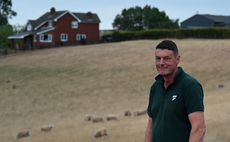
For Warwickshire beef and sheep farmer Adam Quinney, running a self-propelled and self-loading diet feeder has increased the efficiency of his operation, allowing him to feed and bed down 100 suckler cows and all finishing cattle in 90 minutes.
Based at Reins Farm, near Redditch, Mr Quinney was an early-adopter of the diet feeder, running horizontal auger machines to feed his suckler and beef finishing enterprise as long ago as the 1990s. About 10 years ago he switched to his first trailed vertical auger machine, to allow more effective incorporation of long fibre ingredients, such as big bale straw, into rations, but was by then already aware of the potential advantages of going self-propelled.
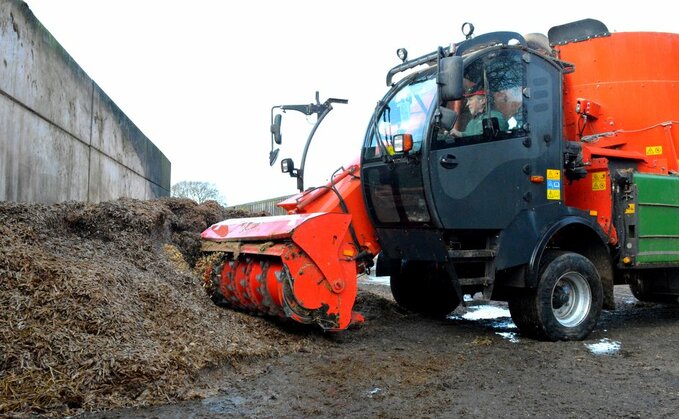
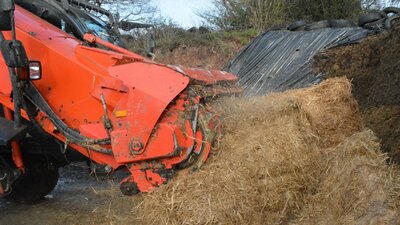
"It was on a trip to Italy in 2008 where I first saw a self-propelled diet feeder in operation," he says. "The most striking observation was how well the system reduced waste, particularly at the silage pit where the self-loading milling head was leaving the face neat, minimising secondary fermentation."
He made the step from a trailed machine to self-propelled about 10 years after first seeing the machine in Italy. "We had been running a 12 cubic metre single vertical auger Kuhn tub mixer without any problems," says Mr Quinney. "It suited us at a time when we were starting to include more long fibre in the rations, as it handled that more efficiently than the horizontal auger machines we had previously. It ran well on a small International tractor and was ideal for the number of smaller mixes we needed at that time.
"However, we had reached a point where we were over-filling it, and were looking at a bigger tractor. Our JCB Loadall also needed changing and then the shear grab broke."
These events coincided with the opportunity to buy one of Kuhn's SPW self-propelled diet feeders, as an ex-demonstrator, but before making the final commitment he undertook a process of sense-checking to verify what he believed would be key savings.
"We measured our diesel use over a period of days using the JCB loader and the trailed feeder and then compared this with the fuel consumption of the self-propelled machine," he says. "Fuel use was halved with the self-propelled machine, so even at today's cheaper diesel costs it is a significant monetary saving."
Mr Quinney recently completed his second winter with the SPW 25.2 CL, a twin vertical auger self-propelled machine with a 25cu.m capacity and a front cross conveyor that can despatch to right or left.
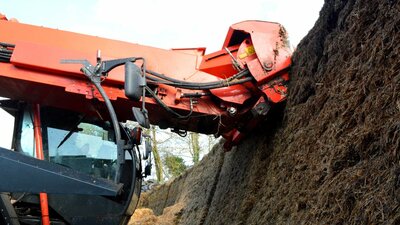
He has seen significant improvements at the clamp with the use of the two metre-wide milling head. "We reckoned to leave a pretty tidy clamp face with the shear grab, but the job done by the milling head is so much better," he says. "The face is left neat and tidy, avoiding secondary fermentation, and anything that falls to the floor is then picked up.
"There is a big time saving because the mixing is going on while you are loading, and there is no risk at all of dropping forage or other feeds around the yard."
With a herd of 100 Saler cross sucklers, calving outside in June and July, he feeds a winter ration comprising of big bale straw and mature grass silage to maintain condition before cows are turned out in the spring. Finishing cattle receive a more complex ration, with a variety of energy sources being bought in to balance high protein red clover silage.
"The SPW has automated weighing and a digital display, with programmable software that allows rations to be pre-set according to different groups of cattle," he explains. "This allows a high level of accuracy as the ration components are loaded, and similar precision with the feed-out, and it is all recorded and transferred to the office computer via a memory stick."
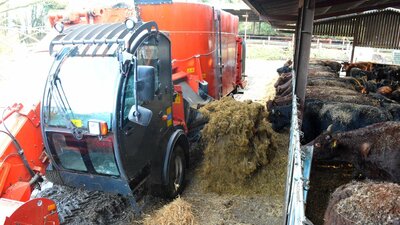
Variable speed augers allow the ration chopping and mixing intensity to be adjusted according to the ingredients, avoiding over or under-processing and allow the best possible presentation of the feed. Furthermore, Mr Quinney says the conveyor speed is easily adjustable from the cab, which, when combined with hydrostatic drive, ensures the feed is delivered along the entire feed area in one even pass.
He admits that the SPW 25.2 is probably one size bigger than they would ideally have bought, but manoeuvrability is not a problem around his buildings thanks to four-wheel steer and the camera system. Out on the road, the 244hp Iveco engine is comfortable at up to 40kph.
"It brings higher levels of control and efficiency that would ever be possible from our previous system," he adds, "but in reality it is a machine that is more akin to a combine than a scraper tractor so does require more than a minimum skill level to get the best out of it."
Prior to buying the Kuhn machine, Mr Quinney researched the market thoroughly and looked at several alternative self-propelled diet feeders, and ultimately put back-up and servicing as one of his first priorities.
"This is a complex machine so it is important to have confidence in the reliability and the technical expertise from the local dealer as well as the manufacturer," he adds. "Having had the experience of a Kuhn diet feeder previously, we knew all about the strength and build quality, and had a good relationship with the local dealer. Added to this, Kuhn is not far away at Telford."
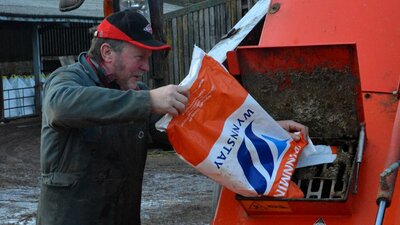
Mineral loading
Verdict
All things considered, going self-propelled has allowed Mr Quinney a significant step towards a system that is more efficient and creates less waste. As importantly, it is allowing him to function, for the most part, as a one-man operation.
听
Automating feeding has made it possible for Adam Quinney to work more efficiently so he can fulfil off-farm commitments without employing outside help. It also offers the capacity to finish cattle for others in the future whilst avoiding the cost of extra labour.